I Drank Alkaline Water for 30 Days. Here’s What Nobody Tells You.
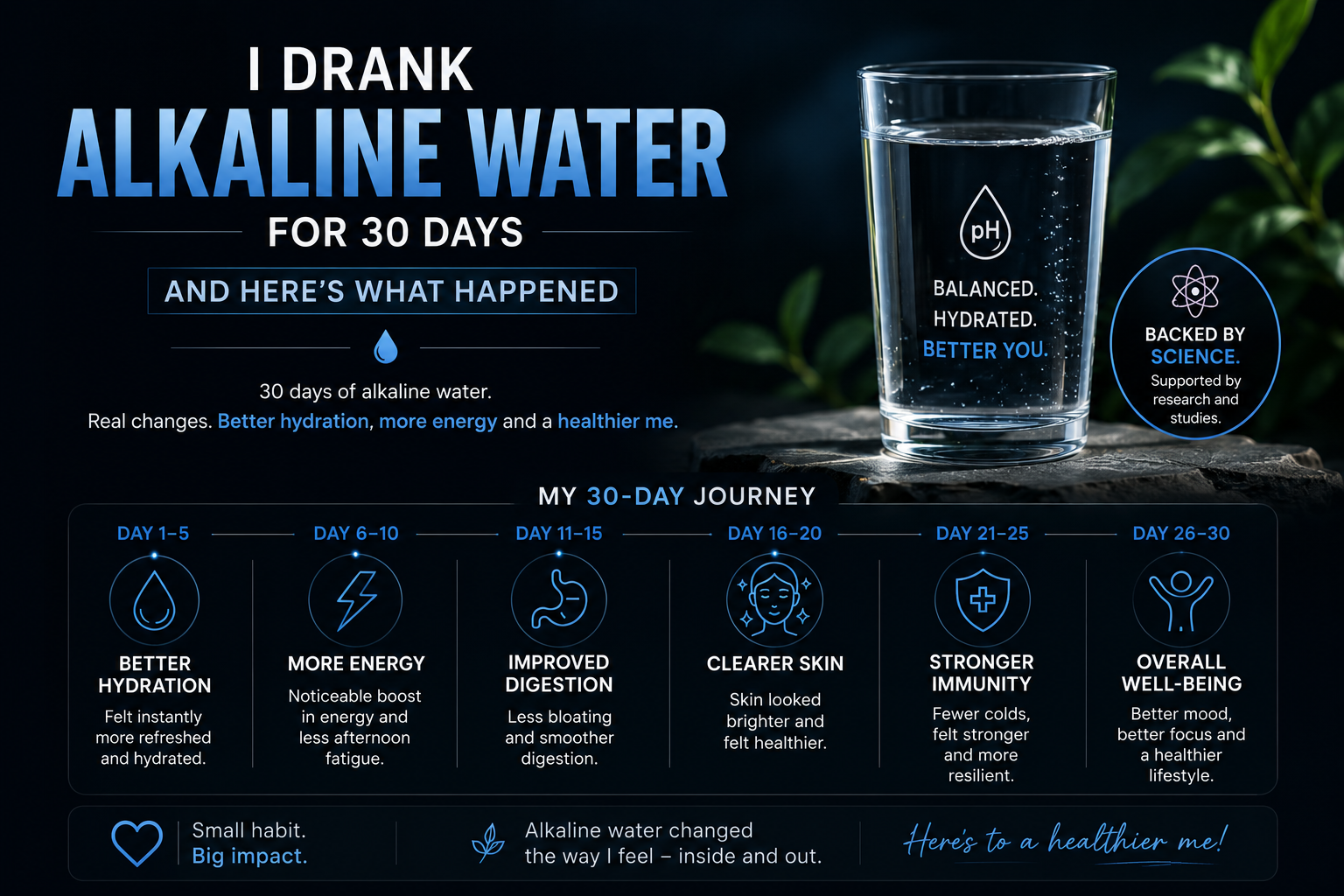
Thirty days. Every morning, a glass of alkaline water before coffee. Every workout, a bottle of pH 9.5 instead of whatever came out of the tap. I tracked how I felt, looked at the research, talked to a sports dietitian, and came out the other end with an opinion nobody in the alkaline water space seems to want you to have: it’s not magic, it’s not a scam, and the conversation around it is almost entirely dishonest — on both sides.
How I Got Into This
My gym started stocking it. A trainer I respect mentioned it casually, the way people mention things they half-believe. “Good for recovery,” he said. That was it. No study, no explanation. Just a confident statement from someone whose opinion I’d been conditioned to trust about his area of expertise.
I bought a case. Then I started reading. What I found was a marketing industry built on real chemistry, misapplied biology, and the kind of confident half-truth that’s genuinely hard to argue with at a party.
The Claim, Stated Plainly
The pitch goes like this: modern diets — processed food, meat, sugar, alcohol, stress — make your body acidic. An acidic body is a sick body. Alkaline water counteracts this acidity, bringing you back into balance. The result: better energy, better skin, slower aging, improved athletic performance, reduced cancer risk.
It sounds reasonable. pH is a real thing. Diet does affect body chemistry. Acidity is genuinely bad in certain medical contexts.
The problem is that almost every step in that chain of reasoning is wrong, or at least badly oversimplified.
Your Body Is Not “Too Acidic”
Let’s get the biology out of the way.
Your blood pH runs between 7.35 and 7.45. Your kidneys and lungs keep it there — constantly, automatically, regardless of what you eat or drink. Drop below 7.35 and you’re in acidosis, a medical emergency. Climb above 7.45 and you’re in alkalosis, also a medical emergency. Neither happens from eating too many burgers.
When alkaline water marketers talk about “acidity,” they’re not talking about blood pH. They’re talking about something called the “acid-ash hypothesis” — the idea that certain foods leave an acidic residue after metabolism and that this residue affects your health. This hypothesis was popular enough in the early 2000s that it influenced diet trends and several books. By the mid-2010s, the research had mostly moved on. The kidneys handle dietary acid load without any help from your water bottle.
Here’s what I didn’t expect: knowing this made me more interested in alkaline water, not less. Because if the main claim is wrong, why do some people swear by it? That’s a more interesting question than “does it alkalize your body?” (It doesn’t, not in any meaningful systemic way.)
What’s Actually in the Bottle
Not all alkaline water is the same, and this drives me slightly crazy because the industry treats them as interchangeable.
Naturally alkaline water picks up minerals — calcium, magnesium, potassium, bicarbonate — as it moves through rock. These minerals raise the pH and also provide genuine nutritional value. Some of the most famous spring waters in the world are naturally alkaline. You’ve been drinking alkaline water your whole life without knowing it if you’ve ever had a glass of Evian (pH around 7.2) or San Pellegrino (pH around 7.7).
Ionized alkaline water is different. A machine uses electrolysis to raise the pH electrically, splitting water into alkaline and acidic streams. The result has a higher pH but not necessarily more minerals. Some ionizers also produce molecular hydrogen in the water, which has its own separate (and slightly more interesting) body of research.
When you’re buying a $3 bottle at a 7-Eleven, you’re probably getting either mineral water with a higher natural pH or filtered water that’s had minerals added to raise the pH. When someone’s selling you a $3,000 countertop ionizer, they’re selling you something different, with different mechanisms and different (though still limited) evidence.
The alkaline water market tends to blur all of this together. Same label, same claims, very different products.
The Studies Worth Knowing
There are a few places where the research gets genuinely interesting, even if it’s nowhere near conclusive.
Acid reflux. A lab study from 2012 found that water at pH 8.8 permanently deactivated pepsin, an enzyme that damages throat tissue in people with acid reflux. This is a real mechanism. The research was done in lab conditions, not in humans, but a small number of ENT doctors acknowledge it as worth trying for patients with laryngopharyngeal reflux who haven’t responded fully to standard treatment. This is probably the strongest specific use case for alkaline water. It’s also the most underreported, because it’s far less sexy than “anti-aging.”
Exercise hydration. A 2016 study found that people who drank alkaline water after high-intensity exercise had lower blood viscosity — meaning their blood flowed more easily — compared to those who drank regular water. The study had 100 participants, which is decent. It was industry-funded, which is not disqualifying but worth knowing. Blood viscosity matters for cardiovascular efficiency. Whether the effect is large enough to be practically meaningful in non-elite athletes is genuinely unclear.
Molecular hydrogen. This is the area I find most interesting, and it’s mostly separate from pH. Some ionizers and some alkaline water products contain dissolved hydrogen gas (H2). There’s a body of research — mostly from Japan, where this is taken more seriously than in the West — suggesting that molecular hydrogen has antioxidant properties and may reduce inflammation markers after exercise. The research is still early. But it’s the kind of early research that deserves attention rather than dismissal.
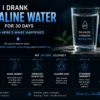
What Happened When I Drank It for 30 Days
Honestly? Hard to say.
Week one, I felt good. Probably placebo. I knew I was doing an experiment and I was paying more attention to my body than usual, which always makes things feel better.
Week two, no different from normal.
Week three, a rough patch — bad sleep, stress at work, one terrible workout. The water did not help. This is what people don’t tell you about wellness experiments: life keeps happening, and you can’t isolate the variable.
Week four, I felt fine. I’d been drinking more water overall because I was tracking it. That probably mattered more than the pH.
What I didn’t get: clearer skin, more energy, miraculous recovery, any sense that my body had been “alkalinized” in some transformative way. What I might have gotten: slightly less post-workout muscle soreness, though I can’t rule out that I was simply sleeping better that week.
One thing I noticed: I liked the taste. Several brands have a softer, slightly silky quality that regular water doesn’t. I’m told this comes from the mineral content. It made me drink more water without thinking about it, which is probably the most honest benefit alkaline water has to offer.
The People Selling It
I spent some time on alkaline water company websites and in a few online communities dedicated to ionizer machines. What I found was a strange mix of genuine believers, people with real health struggles looking for answers, and some fairly aggressive multi-level marketing energy.
The ionizer machine space in particular has a cult quality. Machines costing $2,000 to $5,000 are sold through distributor networks. Testimonials are everywhere. Some communities veer into territory that should require a medical disclaimer — claims about reversing diabetes, eliminating cancer risk, curing autoimmune conditions.
None of that is supported by evidence. Some of it is actively dangerous if it causes people to delay real treatment.
I want to separate this from the product itself. Alkaline water — the water — is fine. The community that has grown around high-end ionizers is something different, and worth being suspicious of.
The Honest Version of the Pitch
Here’s what I’d want to know before buying alkaline water, stated without the mountain imagery:
If you have acid reflux, especially the kind that affects your throat, there’s a plausible mechanism by which high-pH water might help. Worth trying. Cheap to experiment with.
If you’re a serious endurance athlete looking for marginal performance edges, the hydration data is worth your attention. Don’t spend $4,000 on an ionizer for this. Buy a few cases, run your own experiment.
If you’re interested in molecular hydrogen specifically, look for products that specifically test for dissolved H2 — most don’t, and pH alone doesn’t tell you if hydrogen is present.
If you’re buying it because it will make you healthier in general, slow your aging, or detox your system: you’re buying the label, not the water. Save the money. Drink more tap water.
After 30 Days
I still drink it occasionally. Not because I believe the claims — I don’t — but because I genuinely find it more pleasant than plain filtered water, and pleasant things are easier to do consistently.
But I buy it the same way I’d buy sparkling water or herbal tea. As a beverage preference, not a health intervention. The moment I started treating it as the latter, I was paying for a story rather than a product.
That’s most of what the alkaline water industry sells. A story that sounds like science, told to people who want a simple answer to a complicated question. The water is fine. The story is the expensive part.